
Poll: Most Oregon voters want Measure 110 to remain
By Evan Schreiber
ORTLAND, Ore. — A new poll shows a controversial drug law in Oregon still has strong support statewide.
Oregonians overwhelmingly voted 'yes' on Measure 110 in November 2020 to decriminalize the use of small amounts of hard drugs and open up money for addiction treatment.Backers of the ballot measure hailed it as a revolutionary move for the United States. Two years later, those same supporters are pleading for patience while high-profile critics and opponents are already wanting to repeal the law.
The latest numbers from a survey taken in August show that 58% of people think Measure 110 should remain in place while 36% think it should be repealed.
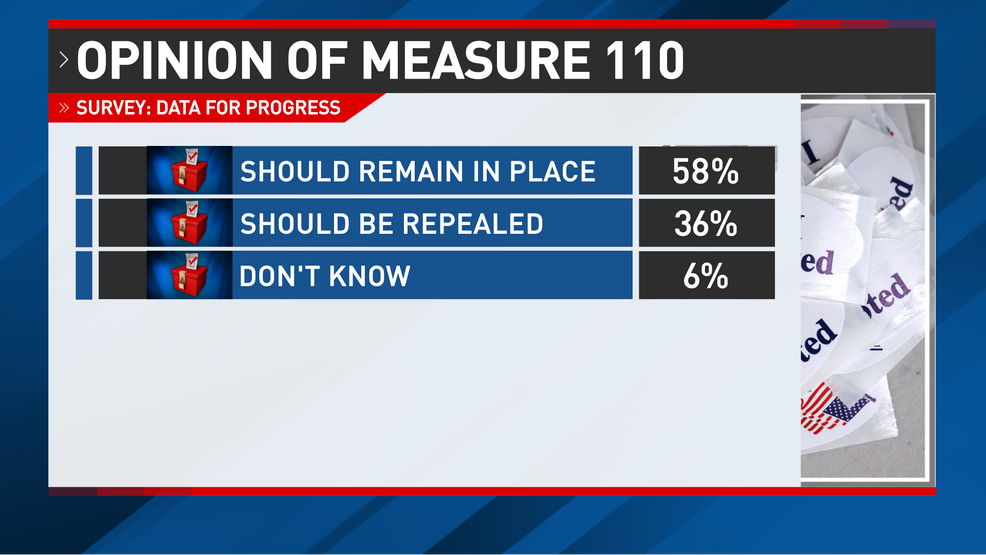
The self-described progressive polling group Data For Progress conducted a survey of 1,051 likely voters in Oregon using SMS and web panel respondents.
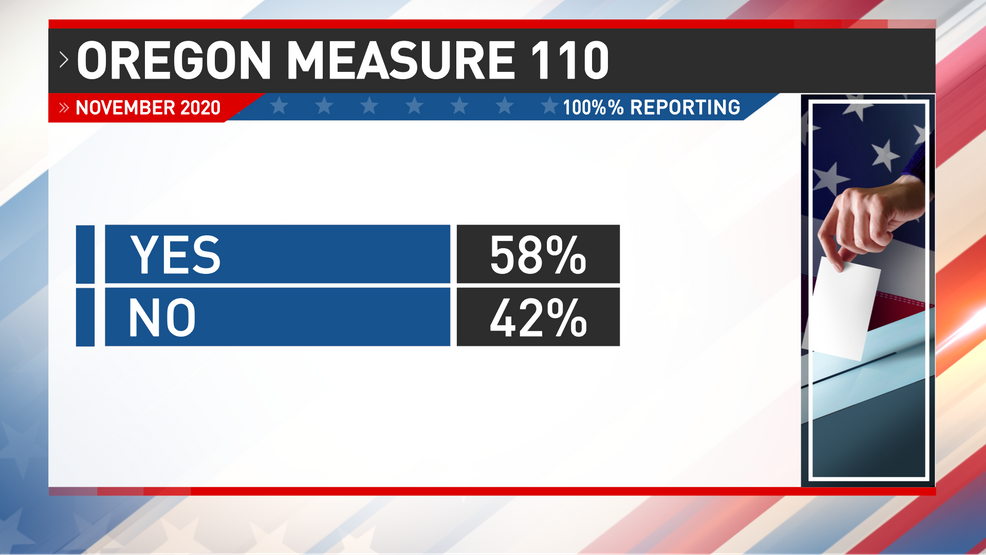
And if you compare that to November 2020, when Oregonians actually submitted their ballots and voted to approve the measure, the margin is about the same. Roughly 58% voted 'yes' to approving Measure 110 on the 2020 ballot while about 42% voted 'no.'
"That’s always good to see. There’s no buyers' remorse," said Tera Hurst, executive director of the advocacy groupHealth Justice Recovery Alliance. "What it shows is that people really believe substance use and addiction should be treated in the public health system and not as a criminal justice issue."
Hurst has been advocating for the landmark law since signatures were first submittedto the secretary of state's office, in order to get the measure on the ballot in 2020.
Now, nearly two years later and more than a year after Measure 110's implementation, the Oversight and Accountability Council has approved the 36th and final Oregon county for drug treatment and recovery services funding. The council, made up of volunteers who applied to serve as members, was tasked with taking all that money designated for drug treatment from the state's marijuana tax revenue, and dividing and distributing the dollars to all of Oregon's counties.
That approval process was just finished late last month - behind schedule.
Measure 110 required the Oregon Health Authority to establish at least one Behavioral Health Resource Network (BRHN) in each Oregon county. As of early September, the council had approved 44 BHRNs in Oregon's 36 counties - with several counties being served by more than one network – each offering community-driven and culturally specific drug treatment and recovery services, OHA explained.
OHA explained that the council has awarded more than $264 million in BRHN funding since approving the first of the state’s networks in May.
"For folks who maybe were concerned or nervous about Measure 110 and maybe the decriminalization coming before the services, they’re recognizing that we’ve had decades to invest in these services and we have not done that – that is why we are 50th in the nation[for access to treatment]," Hurst said. "So, if ensuring people don’t have barriers to housing and employment through the decriminalization component of it, and having $300 million being invested into services that we have not invested in, I would hope that anyone looking at that would say, ‘Huh, yes, this is the right approach.’ And transformational laws like this take time."
But the law is not working fast enough, nor effective enough, if you ask Oregon's major candidates for governor.
Both Republican Christine Drazan and unaffiliated candidate Betsy Johnson have told KATU they would work to repeal Measure 110. Democrat Tina Kotek admitted the law's flaws but wasn't ready to give up on the measure.
"I think that folks that didn’t like the law two years ago, probably still don’t," Hurst told KATU when asked about the criticism. "We’ve had some bumps in its first year. So I would say it’s really on track in making positive changes. Oregon voters were right to pass Measure 110. And if people are going to run on a platform to repeal it, they are running on a platform to overturn the will of the voters."
Much of the candidate's disappointment is in the decriminalization aspect of Measure 110 and the survey showed that many Oregonians agreed.
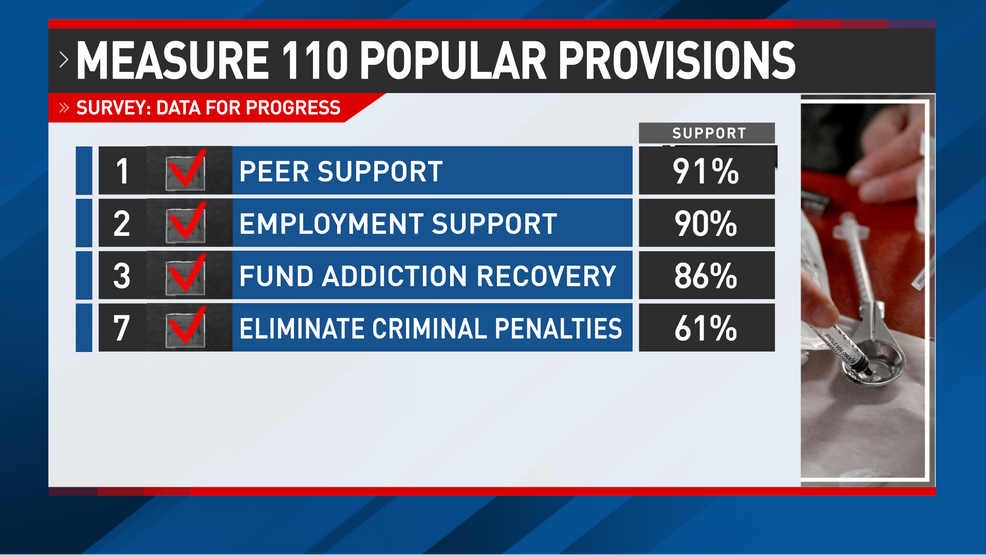
The Data For Progress poll found that of all the provisions produced by Measure 110 - including boosting peer support (91%), employment support (90%), and funding more addiction recovery services (86%) - the elimination of criminal penalties got the least support from those surveyed. Although, still a majority were in favor of decriminalization (61%).
Hurst said it will take more education and understanding to keep the support strong.
"We need to do a better job explaining how the ‘war on drugs’ has impacted the communities who were most targeted," Hurst said. "If we could have the broader community and a lot of folks in law enforcement reiterate that breaking and entering is still illegal and still a crime, dealing is still a crime. There are still plenty of crimes related to drug use. All that decriminalization did – even though it’s significant – is say that if you’re caught with a small, user amount of drugs in your pocket we’re not going to put life-long barriers on you."